











Balancing School Fees, Retirement, and Family: How to Plan Tax-Efficiently While You’re Earning at Your Peak

Introduction
You’ve reached the stage of your career where income is strong, but financial commitments are at their highest. Between supporting children, possibly helping aging parents, and thinking ahead to retirement, your finances are stretched in more directions than ever.
For many families, private education is a key part of that picture. Independent schools continue to grow in popularity for their strong academic results, extracurricular opportunities, and smaller class sizes. According to the Independent Schools Council (ISC), a record 556,551 pupils now attend 1,411 member schools, the highest since records began in 1974.¹
However, giving your children the best education available comes at a significant cost. The average annual day fee stands at £23,925, rising to £42,459 for boarding pupils.² With VAT being applied to school fees from January 2025, those averages could climb to £28,710 and £50,951 respectively.
Over a full school career, that equates to around £460,000 in day fees or £815,000 in boarding fees per child. For families balancing multiple priorities, that is a substantial commitment.
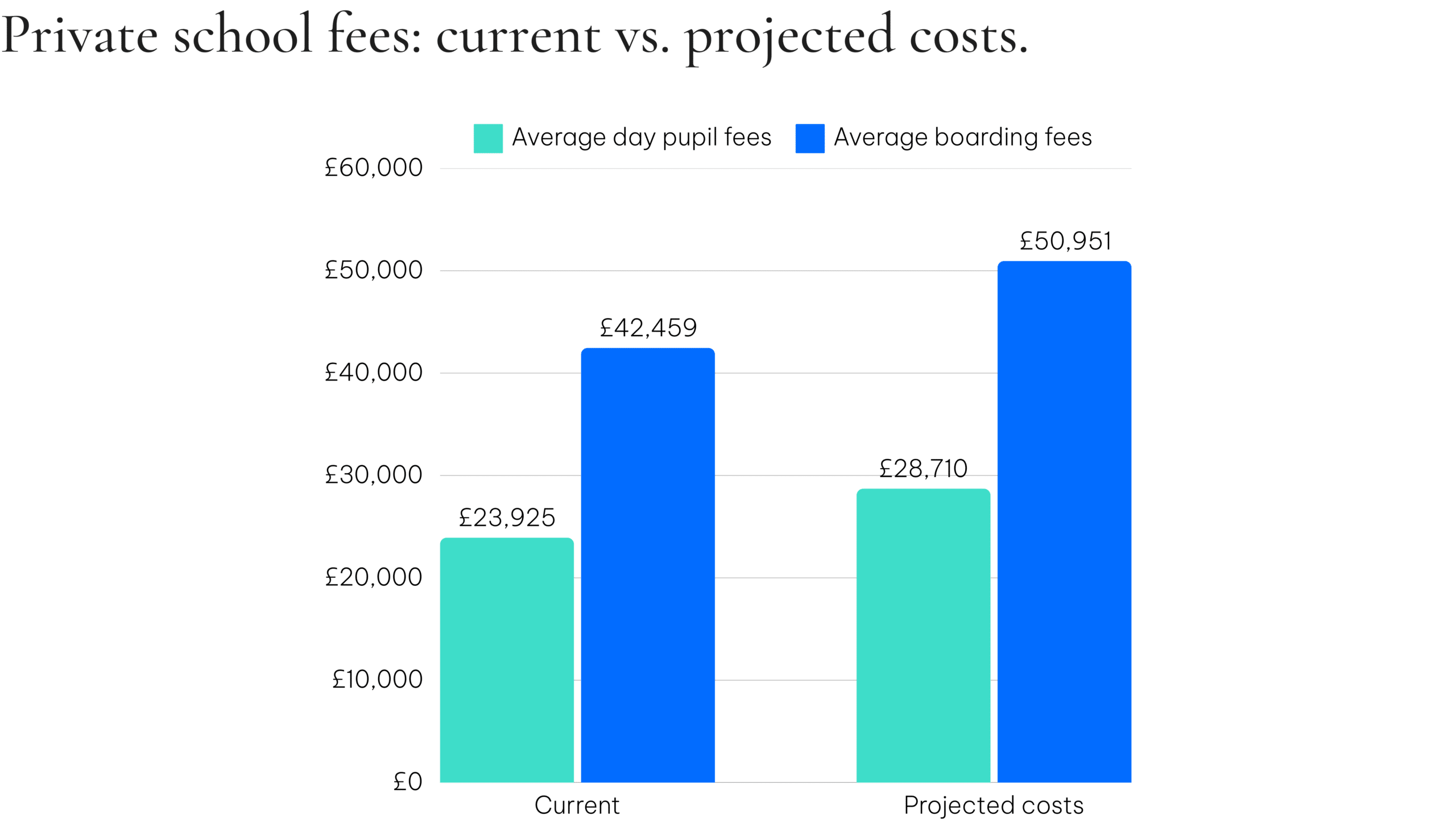
1, 2 ISC Census and Annual Report, January 2024

At a glance
- Average school fees could reach £460,000–£815,000 per child.
- School-fee planning can sit alongside pension saving and retirement goals.
- ISAs, Bonds, and GIAs help with tax-efficient investing.
- Early, structured planning avoids cash-flow pressure later.
Take Your Autumn Statement Impact Assessment
Start NowEducation Costs in Context
Let’s assume school fees increase by 3.5% per year. Even at that modest rate, the total cost of private education rises significantly over 14 years. Planning early can help you manage these costs without compromising other goals, such as pension contributions, mortgage payments, or caring for relatives.
With your income at its peak, you have a unique opportunity to direct surplus earnings into investments that support both short-term needs, like education fees, and long-term objectives, like retirement.
Balancing Priorities: Family, Retirement, and the Future
This is often described as the “sandwich” stage of life: providing for your children while also supporting parents and planning for your own future. Education fees, university savings, and retirement funding can all coincide.
The key is coordination. Integrating your education savings into your wider financial plan allows you to take advantage of tax efficiencies, manage liquidity, and ensure that your hard work today translates into long-term security tomorrow.
Key tax-efficient solutions
SAs are one of the simplest and most flexible ways to invest for education costs. You can save up to £20,000 per adult per tax year (2024/25), and all growth and withdrawals are free from income and capital gains tax.
If both parents maximise their ISA allowances from a child’s birth and achieve 5% net annual growth, the pot could grow to around £585,000 by the time the child is 11 years old (illustrative only).
ISAs also provide flexibility. Withdrawals can be timed to coincide with term dates, and if education costs end up being lower than expected, the funds remain accessible for other goals such as mortgage reduction or retirement savings.
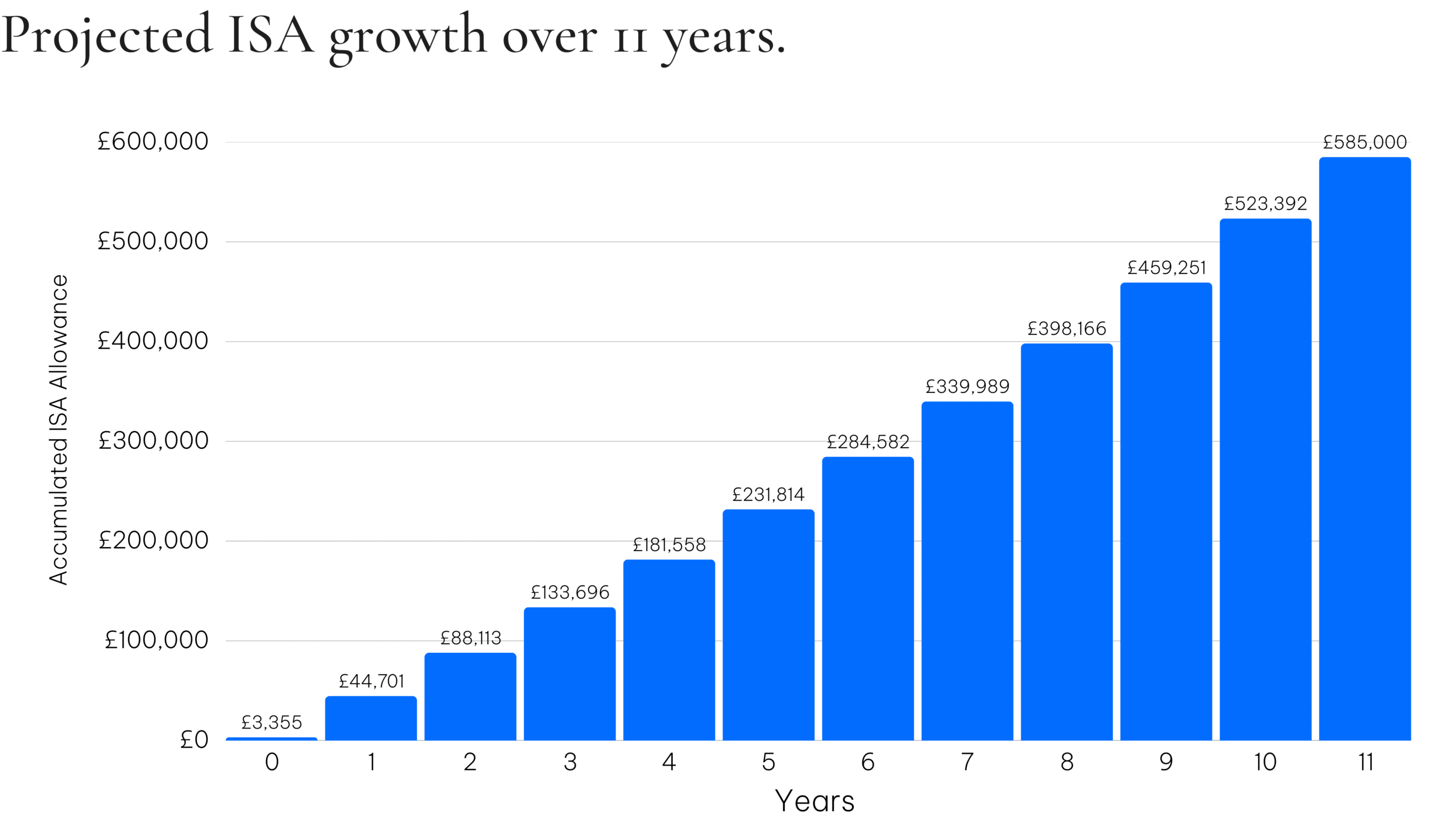
*These figures are examples only and they are not guaranteed – they are not minimum or maximum amounts. What you get back depends on how your investment grows and the tax treatment of the investment.
The value of an ISA with St. James’s Place will be directly linked to the performance of the funds selected and may fall as well as rise. You may get back less than you invested.
The favourable tax treatment of ISAs may be subject to changes in legislation in the future.
Investment Bonds allow you to invest lump sums or regular contributions in a tax-deferred structure. During the life of the bond, returns are not immediately subject to income or capital gains tax, which can make them effective for long-term planning.
You can withdraw up to 5% of your original investment each year for 20 years without an immediate tax charge, and any unused allowance can roll forward. This can align well with paying school fees in instalments, while leaving the capital invested.
For higher earners approaching retirement, Bonds can also help manage future income levels by deferring tax to years when you may be in a lower bracket.
The value of an investment with St. James’s Place will be directly linked to the performance of the funds you select and the value can therefore go down as well as up. You may get back less than you invested.
The levels and bases of taxation, and reliefs from taxation, can change at any time. The value of any tax relief depends on individual circumstances.
Please note that if the withdrawals taken exceed the growth of the bond, the capital will be eroded.
Unit Trusts and GIAs offer flexibility and access to a wide range of assets including shares, bonds, and property. Once you have used your ISA allowances, these accounts can be useful for medium- to long-term investing.
Investors currently benefit from a £500 dividend allowance and a £3,000 capital gains allowance (2024/25). While gains and income are taxable, these accounts allow you to manage when and how you realise profits, helping you to plan tax efficiently.
For high-earning families, this can provide a balance between growth, liquidity, and control over timing withdrawals for school fees or university costs.
The value of an investment with St. James’s Place will be directly linked to the performance of the funds you select and the value can therefore go down as well as up. You may get back less than you invested.
The levels and bases of taxation, and reliefs from taxation, can change at any time. The value of any tax relief depends on individual circumstances.
Families often help across generations, and the £3,000 annual gifting allowance can be a useful way for grandparents to contribute toward school fees. Couples can combine their allowances to gift up to £6,000 per year tax-free.
Larger gifts may also be exempt from inheritance tax (IHT) if the donor survives seven years, or if they are made from regular surplus income.
Parents with sufficient income can also pay directly for education costs under the “Dispositions for the maintenance of children” rules, which means these payments are not considered transfers for IHT purposes.
A disposition is exempt if it is:
– in favour of a child of either party to a marriage or civil partnership, and
– for that child’s maintenance or education before age 18, or while in full-time education.
The levels and bases of taxation, and reliefs from taxation, can change at any time. The value of any tax relief depends on individual circumstances.
Further criteria applies within the HMRC IHT Manual IHTM04175 which is subject to change.
Private schools offer a range of scholarships and means-tested bursaries. Approximately one-third of pupils in private education receive some level of financial assistance.³
Bursaries are awarded based on financial need, while scholarships recognise academic, sporting, or artistic achievement. Even partial awards can reduce the overall cost of education and ease pressure on family finances.
3 ISC School Fee Assistance, April 2023
If you have accumulated savings or a bonus, some schools offer discounts for paying fees in advance. The discount varies by school and the number of years paid upfront.
However, compare the potential saving with what that capital could earn if invested instead. Retaining flexibility and liquidity is often more valuable than a modest discount, especially when you are balancing several major financial goals.
Planning for the Years Ahead
Private education is a significant investment, but one that can sit comfortably alongside your other priorities with the right planning. Integrating education costs with retirement, inheritance, and protection strategies can help you manage cash flow and preserve wealth for the long term.
As your income peaks, this is the ideal time to use that advantage to secure both your children’s opportunities and your future financial independence.
The value of an investment with St. James’s Place will be directly linked to the performance of the funds selected and may fall as well as rise. You may get back less than you invested.
The levels and bases of taxation, and reliefs from taxation, can change at any time and depend on individual circumstances.

Should you require more information or have particular questions, we invite you to contact us at your convenience.
Contact Us
Nauman Gondal
Chief Executive Officer